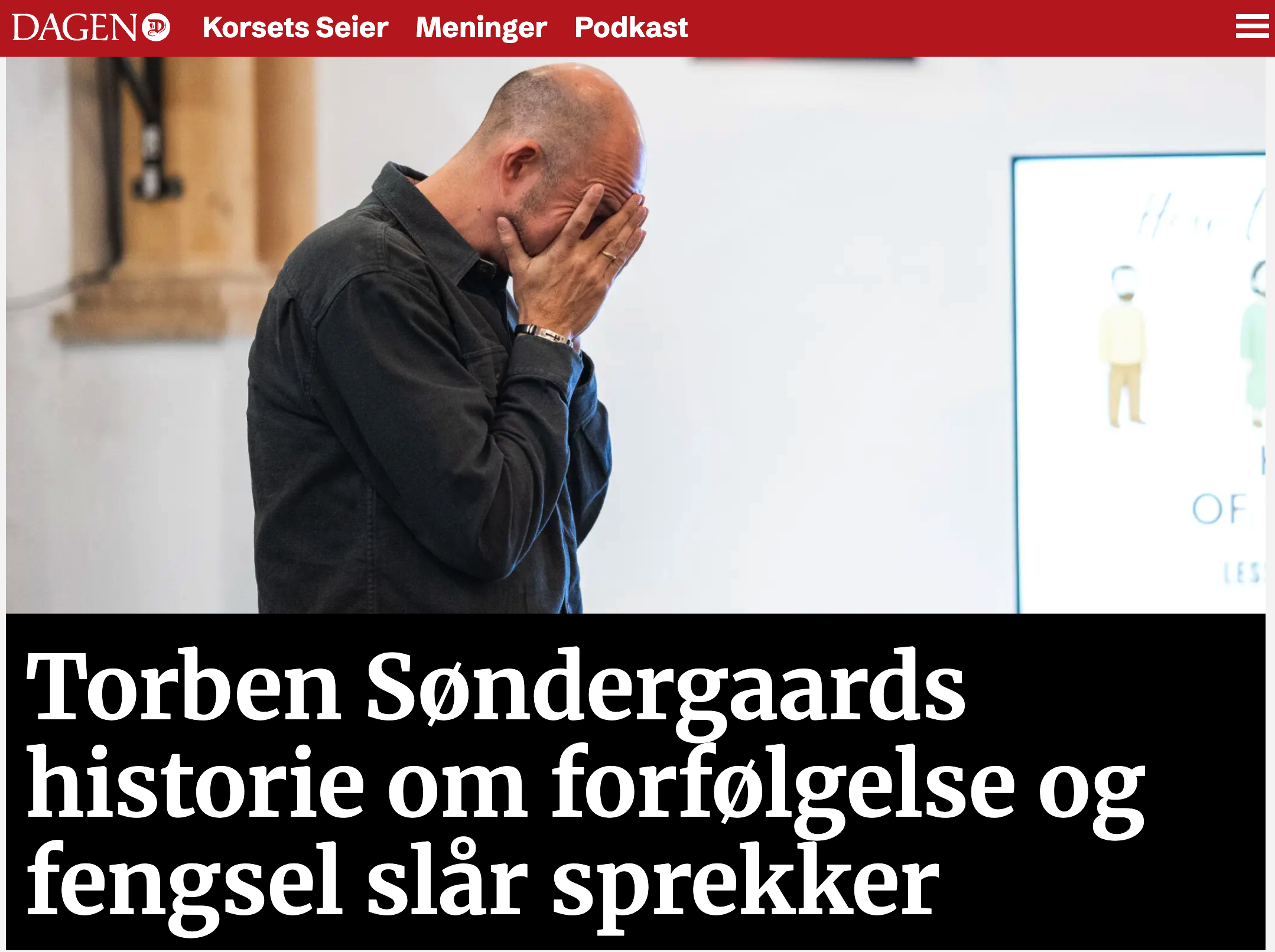
Here you see the front page of the newspaper Dagen, a national Christian newspaper in Norway.
We are under significant attack these days, and we truly thank you all for your prayers and support.
The headline: Torben Søndergaard’s story of persecution and imprisonment is falling apart.
Let me say this clearly: It is not. It stands firm.
The front page itself is misleading. They have chosen a photo of me from a teaching session (from teaching on the fivefold ministry), where I am standing with my head bowed, moved—perhaps praying. That moment has nothing to do with my persecution or imprisonment. Yet it is used together with a headline to create the impression that my story is collapsing.
Nothing could be further from the truth.
I am not against critical questions. Journalists should ask questions. But when a newspaper deliberately frames a photo and headline to create a false impression before people even read the article, that is serious.
This is only part of the attacks we are experiencing right now. We ask you to continue praying for us and standing with us, because the enemy is truly coming against what God is doing.
At the same time, we are seeing beautiful things happen. Disciples are being made. People are encountering God. Lives are being transformed. And that is exactly why resistance comes.
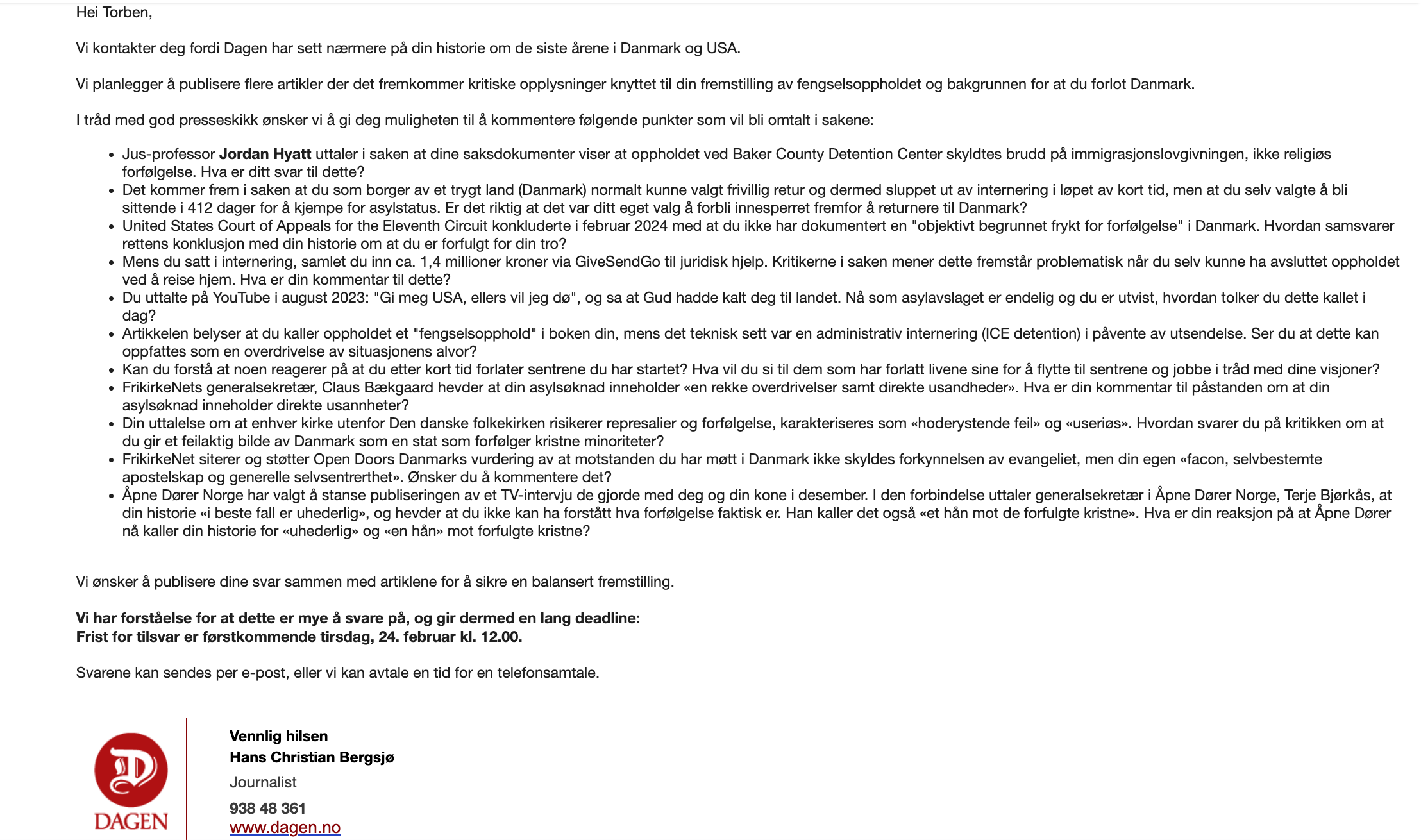
Below you can see the email I received from Dagen and my full responses in english.
I encourage everyone to go to the timeline we have published and read the documents for yourselves, in full context:
https://www.torbensondergaard.com/timeline
I also encourage you to read the book 412 Days, where the whole story is documented:
In norsk: https://www.mediaforlag.no/shop/product/412-dager
If you would like to support the work we are doing in Norway, we deeply appreciate it. It means a lot.
Let us not become divided in this time. Let us stand together. God is doing something beautiful, and we will not bow under attacks like this.
Thank you for your prayers and support for me and my family in what we are going through.
God bless you.
Torben Søndergaard
https://www.givesendgo.com/412DAYS
1020.36.10365 (Disippeltrening Norge)
Vipps: #966254
Hi Hans Christian,
Thank you for your inquiry. Below you will find my responses to the questions you have raised.
I am aware that my answers are longer than you may have expected. However, it is incredibly difficult to reduce this to just a few lines without losing crucial details and without distorting the understanding of what actually took place. And that has been a recurring problem: when there is only room for a very brief explanation, what actually happened disappears.
I would like to emphasize that there are aspects of this case that are still ongoing, and that there are also parts that involve processes where authorities and/or other bodies are still working on the matter. Therefore, it is especially important that this is handled with the thoroughness and responsibility that a complex and ongoing case requires.
I understand that you may not be able to use all of my responses in the article. However, I would strongly encourage you to ensure that whatever you choose to quote is presented accurately and in the proper context — so that it is not edited in a way that creates a misleading impression.
It is also worth mentioning that immigration in the United States is a highly politicized area, and that there are often agendas behind which sources are cited and which angles are chosen. Therefore, I hope you will take an extra step to investigate the matter thoroughly, so that readers receive as fair and accurate a picture as possible.
My legal team in the United States is involved in this process. If you have legal questions or need to have facts double-checked, they are available. I am not seeking conflict — I simply want this to be handled properly.
I have attached some documents here for you to review. If you have any questions or need additional documents, we have them available.
In addition, we have hours of recordings from a civil case in which a person, under oath (with their hand raised), explained what has taken place. These recordings have not yet been made public, but they form part of the ongoing process.
Naturally, I am also available for follow-up questions or a brief conversation if you would like further details or clarification.
Kind regards,
Torben Søndergaard
Law Professor Jordan Hyatt states in the case that your case documents show that your stay at Baker County Detention Center was due to violations of immigration law, not religious persecution. What is your response to this?
I fully understand that one can read the case documents and conclude that this was “simply” an overstay case. That was the legal terminology that was used.
However, if one looks at the entire course of events and all the documentation, it is not that simple.
I entered the United States legally on January 26, 2019. I applied for asylum on April 19, 2019 — before my visa period expired. The application was accepted and registered (I-797 Notice of Action). That means I was in a lawful process while the case was being handled.
(What I am explaining here is also documented in the attached congressional material.)
All documents are publicly available at www.TorbenSondergaard.com/timeline.
As an asylum applicant, you are in a legal process. Therefore, it is not accurate to describe me as a classic “overstay.”
At the same time, it is important to understand the political context in the United States. Immigration is one of the most politicized areas of American politics. Changes in administration can significantly affect priorities and enforcement. That must be taken into consideration.
My case was officially mentioned in the United States Congress on July 26, 2023, by Congressman Clay Higgins, who at the time was Chairman of the Border Security and Enforcement Subcommittee — the committee that oversees ICE.
And here I would ask a simple question:
How many ordinary overstay cases end up in the United States Congress?
Almost none.
The fact that my case was raised there in itself shows that there was something unusual about it.
Clay Higgins stated, among other things:
“He came to our country legally and applied for asylum properly. No criminal charges. He has been persecuted by this administration and targeted, we believe, because he’s an Evangelical Christian minister.”
Those are not my words. They were spoken publicly in Congress in connection with an inquiry into what was actually happening in my case.
According to his office, they spent over 400 hours reviewing the case. That alone shows this was not a standard administrative matter.
An important part of the investigation concerned:
Who annulled my visa shortly after I entered the country — and why?
My ESTA/visa was suddenly revoked without any notification to me. In the government database, I was therefore later registered as an “overstay.” That is what is being referred to today.
But according to my documents and my passport, I entered legally and applied for asylum before the visa period expired. That can be documented.
During the investigation, it emerged that an immigration officer involved in my arrest — the one who placed handcuffs on me — had been in contact with a person from Denmark who had pursued me for years.
Yes, it almost sounds like something from a movie.
But it is documented, and the material is publicly available on our website.
In addition, I was classified as a “national security concern.” As a result, I was not treated as a standard immigration case. None of the hundreds of detainees I was held with had that classification — as far as I know.
If one only looks at what appears in a system as “overstay,” one sees only part of the story. When one looks at how my visa was annulled, who was involved, the serious allegations that were raised (such as weapons smuggling and human trafficking), and how the case was handled — a much more complex picture emerges.
Therefore, I do not believe it is accurate to reduce this to a simple immigration violation.
The case was unusual.
It was political.
It was examined at the highest level.
And we have documentation for all of it.
Professor Hyatt of course has the right to his assessment. But one must also understand that immigration in the United States is extremely politicized, and very few people are completely neutral when it comes to politics.
That applies to politicians and officials — but also to commentators and academics who speak publicly.
When people quote Professor Hyatt, it is often because his statements fit into the narrative they already wish to promote. There is often an agenda behind which sources are cited — and which aspects of a case are highlighted.
If one focuses only on a single legal term (“overstay”) and ignores the rest, it can be made to appear as a standard case. But that is not the full picture.
The full picture includes:
• lawful entry and an active asylum process
• that my visa was annulled shortly after entry without notification
• that the case ended up in the United States Congress
• that Clay Higgins’ office spent over 400 hours reviewing it
• that I was classified as a “national security concern”
• and that the investigation uncovered contacts that should never have existed
When all of this is taken into account, it is not reasonable to call this an ordinary “overstay” case.
We have made the documents publicly available.
People can read them themselves and form their own conclusions.
You could have chosen voluntary return and been out quickly — but you remained for 412 days. Was that your own choice?
If it had truly been that simple, I would have done it immediately.
From the outside, it is correct that one can stop the case and request removal, and that this can go faster. But “faster” still means 2–4 months. And when I was in the middle of the situation, it did not feel like a real option.
I was fighting daily not to become depressed — especially in the beginning. Every day I heard from my lawyers and from Lene, my wife: “Hold on. Something is happening. You might be out next week.”
That sentence — “next week” or “in a few weeks” — was what kept me going. If you read my book 412 Days, you will also see that this was how the situation was experienced.
When I was arrested on June 30, 2022, I was informed of serious allegations — including weapons smuggling. It was shocking and frightening.
I had already experienced that my ESTA had been annulled in a strange way shortly after entry, without me being notified. I therefore knew something was wrong, without knowing exactly what.
In detention, I initially received no information. The first document I was given described me as “obese” and as a risk to myself if released. It stated that I had been examined by a professional doctor. That was not correct. I have never been “obese,” and I was not examined by any professional doctor at that time. The document is available on our website.
Later, I was accused of human trafficking and classified as a national security threat. At that point, it was no longer just about getting out quickly, but also about ensuring that the case was handled properly and finding out who was behind the false accusations — something we now have greater clarity about.
Therefore, it is not as simple as some people think when they look at the case from the outside.
Yes, if I had given up and not fought, I might possibly have been out after 3–4 months. But it never felt like a real option for me in that situation.
It was an extreme burden — especially when my wife became ill during that period. My family lived in constant uncertainty. If I could have ended it quickly and safely, I would have done so.
That is why it is both sad and unfair when some claim that I somehow “chose” to stay there longer.
All decisions were made based on legal advice and the information we had at the time — not with the benefit of hindsight
What would you say to those who have left their lives behind to move to the centers?
I am not entirely sure what this specifically refers to. Very few people have ever done that — it can be counted on one hand.
It is important here to describe how we are actually organized. People do not leave their lives behind to “move to us” with the intention of staying permanently.
We typically have 2–3 month training schools, and the intention is that after completing the program, participants either go out to the mission field or return home. We make that clear before they come.
Some return and help for a period of time, but very few stay longer than six months. That is also one of the reasons we have been able to grow — because the focus has never been on gathering people around us, but on training them and sending them out.
In recent years, there have been training schools and discipleship training in around 30 countries. I have personally only been physically involved in three of those countries.
The schools are often held in rented facilities that are leased specifically for that purpose. When the school is over, there is no permanent “center” left behind.
There have been a few cases, such as in Denmark, where we rented a center for a longer period and held multiple schools in the same location. But generally, most participants come for a limited period and then move on.
As an organization, we have not owned permanent centers. We have rented temporary facilities and moved on after each school ended. The only place with a more stable base today is in Mexico, and it is run locally by pastors there — and we do not own that either.
The idea that people sell everything and move permanently to be with us is a misunderstanding and not accurate. At present, I can only think of two couples who chose to stay for a longer period.
When the center in Denmark was shut down — not closed by choice — it was the result of a media storm. After that, local sports clubs stopped renting our facilities, and students did not come. As a result, we were forced to shut down. A few couples were left behind in the middle of it, and we are of course sorry for that.
If anyone has made major personal decisions, those have been their own choices. It has never been a condition or requirement from our side.
I would also like to add that many rumors and false accusations are still circulating. Therefore, I welcome an independent third-party investigation, where a neutral body interviews all parties and reviews all relevant documents and materials. This is something I have requested ever since I was released, precisely because I want the truth to come forward and my name to be cleared.
I believe it is absolutely crucial that both sides are heard and that all documentation is reviewed before conclusions are drawn. If there are pastors, lawyers, or organizations who would be willing to help initiate such an investigation, I am open to that.
The United States Court of Appeals for the Eleventh Circuit concluded in February 2024 that you have not documented an “objectively well-founded fear of persecution” in Denmark. How does the court’s conclusion align with your story that you are persecuted for your faith? In other words, why did your view not prevail in court if the documentation is as strong as you describe?
Yes, it is true that we lost the case in the 11th Circuit. But you have to understand the full context.
In our assessment—and according to our legal team—the conclusion was misleading on several points.
First, my case became political. It had previously been raised in Congress, where it was said that I was being persecuted by this administration. That does not mean a court automatically follows politics, but it does show that my case had become something more than an ordinary immigration matter.
Second, the decision was based on assumptions that, in our view, were not correct. One example is that they begin by saying that I had “overstayed” my visa. When we started working on the case, my asylum attorney said it was absolutely crucial that I had not overstayed, because if I had, we would in practice have already lost. Therefore, we did everything we could to submit our paperwork within the deadline.
But the persecution was already underway in the United States. As I have explained previously, our papers in the system were cancelled in their database due to false allegations. As a result, parts of the system could make it look as if I was an “overstay,” while according to my passport and our own documentation, I was not. When the court then gives more weight to the registration in the system than to the documentation we had, I experience that more attention is given to the system’s “version” than to what actually happened.
We have documentation of this process and a review of the case on our website www.torbensondergaard.com/timeline, where Congressman Higgins’ congressional office demanded answers specifically about this registration and the process behind it—in order to find out why I was registered as an “overstay.” That process has since been concluded, and we now know where it came from. See more on our website.
Another argument the court used to say that I was not truly persecuted was that our son Sonni lives in Denmark and believes the same as I do. But that argument makes no sense to me, because he was not the one on national TV week after week. He was not the one experiencing authorities coming again and again, or standing in the middle of the public campaign. He was not the one who traveled to the U.S. and had his papers cancelled on the basis of false allegations. And he was not the one who was registered as a “national security threat” in the way that I was.
Therefore, we believe the comparison is wrong, and that it shows that I was in a completely different situation.
So yes, we lost in the 11th Circuit, but I still believe there are significant factors and documentation that have not been properly understood or given sufficient weight in the decision. We still have material and investigations ongoing, which can be read about on our website.
While you were in detention, you raised about NOK 1.4 million via GiveSendGo for legal help. Critics argue this appears problematic when you could have ended your stay by returning home. What is your comment on this?
I cannot help but ask: What is the real purpose of the ongoing criticism? What is the motive? What drives it?
Let me be very clear about the money that was collected via GiveSendGo. First of all, I did not “profit” from these funds. On the contrary, the entire process cost us everything.
A legal process in the U.S. is extremely expensive. Attorneys, investigations, and immigration processing quickly add up to very large amounts. Before I was imprisoned, we owned—through our organization—two cars, a truck, a trailer, and a large revival tent with space for around 1,000 people. These were tools we used in ministry.
When I was put in jail, many people began donating directly to my legal case instead of to The Last Reformation. That meant fewer funds came in for the day-to-day work. At the same time, I was not holding meetings or doing what I normally do, which also reduced income. But the expenses continued. Suddenly we lacked funds for salaries and fixed costs. In order to pay bills, we had to sell everything—cars, truck, trailer, and tent.
The money that was collected went to lawyers and to cover the expenses that piled up. When I left the U.S., we had about $2,000 left in our bank account. We had lost everything. Bills kept coming afterward, and it was an enormous burden. Some of the bills we managed to pay. Others were eventually forgiven because we simply did not have the means to cover them.
To portray this as if I became rich from it is deeply misleading. And to say that I “could have just gone home,” as if it were a hotel stay, ignores the legal reality. It was also about having the case heard and clearing my name.
When people repeatedly try to create a picture of personal gain or manipulation without engaging with the facts, one has to ask: Why? What is the motive?
And now that the truth has been laid out: Will they believe what I say? Sadly, I think many choose to hold on to a lie rather than hear the truth—precisely because they have a motive.
I therefore encourage people to read the documentation themselves, go through the timeline, and form their own assessment.
You said on YouTube in August 2023: “Give me the U.S., or I will die,” and that God had called you to the country. Now that the asylum rejection is final and you have been deported, how do you interpret this calling today?
When I said on YouTube in August 2023, “Give me the U.S., or I will die,” it was not meant literally, but as a strong spiritual and emotional expression of a calling. It was in the same spirit as the well-known missions phrase often attributed to Hudson Taylor: “Give me China or I die.” It is about describing a deep burden and passion for a country—not dramatics.
I experienced a strong calling to the United States during that period. We have traveled in around 50 countries and had already many years of ministry in the U.S. At the same time, we also experienced a clear calling to Mexico while we were in the U.S. We longed to go there, but could not because the case was still ongoing.
Today we have started a base in Mexico that is growing, and it is wonderful to see what God is doing there. The years in the U.S. were very fruitful, and I do not see the U.S. as necessarily a closed chapter.
For example, on January 24, 2024, I received a text message from Tom Scarella in the U.S. in which he wrote, among other things:
“The USA misses you my friend… I want to encourage you, my friend, you single-handedly awaken the love for water baptism in the hearts of Pentecostal Charismatic people all over the world… I was just speaking with some pastors, and they told me that you provoke them, and really convinced them of their need to get back to water baptism. Thank you for your faithfulness to the call.”
Later I spoke with him, and he confirmed that he still hears about church after church and city after city in the U.S. where there has been renewed focus on baptism.
Of course, I am not claiming that this is something I have done alone. I have only been one among many whom God has used to lift up the biblical foundation again. But it deeply encourages me to see that the fruit continues.
How do I interpret the calling today? I see it this way: callings can have different seasons. A door can be closed for a period without meaning that God is finished. I still sense that there may be more ahead of us in the U.S.
When someone chooses to take one sentence out of its context in order to cast doubt on my person, one has to ask why. The quote must be understood in its full context—as an expression of calling and passion, not as a literal demand.
FrikirkeNet’s secretary general, Claus Bækgaard, claims that your asylum application contains “a number of exaggerations as well as outright untruths.” What is your comment on the claim that your asylum application contains direct falsehoods?
My response to Claus Bækgaard and FrikirkeNet is as follows:
I want to respond factually and with respect. My goal is not to attack anyone, but to bring out the facts and contribute to an orderly process where both sides are heard.
If there are questions related to my asylum application, I encourage Claus Bækgaard to contact my asylum attorney directly. She is available and can—within the legal framework—present documentation in the case, including material that has not previously been made public.
I understand that FrikirkeNet has a responsibility to assess the information you receive, and I respect that role.
To provide some context: Back in 2017, two representatives from FrikirkeNet spoke with me. But already at that time, it was clear that they had beforehand had conversations with a former employee whom we ultimately had to dismiss for several different reasons, as well as a few people around him who chose to take his side. They had heard a number of serious and negative allegations about me.
My experience was that they had already formed a conclusion in advance, and that there was not, in practice, an open process where both sides were investigated and evaluated. They had, in effect, heard one side, but not ours. Nor have they ever spoken with the people who were actually part of the leadership team and the work at that time, and who can give a very different picture of what happened.
I would also add that before we had to dismiss that person, several people came to me and warned me about him. These people should also be heard if one wants a fair and thorough assessment of the case.
Afterward, a letter was circulated in Denmark warning against me and our work. This letter has now also been forwarded in Norway. This largely forms the background for the current debate.
Since then, FrikirkeNet has repeatedly spoken about me and our work in The Last Reformation, but without me experiencing that there has been a real, thorough, and open dialogue with me or anyone from our team. As I see it, their assessments are largely based on information from the former employee and a small environment around him.
As for Claus Bækgaard, as far as I know he has not met me. We have never spoken. And as far as I know, FrikirkeNet has also never spoken with our staff. Our leadership team—many of whom were part of the work back in 2017—are ready to be interviewed so that our side can also be presented properly.
As the Bible says:
Proverbs 18:17
“The one who states his case first seems right, until the other comes and examines him.”
I believe the time has now come for this.
Therefore, I am calling for an independent third-party investigation.
Such an investigation should include:
my asylum application and its basis
the course of events surrounding what specifically happened in Denmark back in 2017
the allegations that have been made
the sources FrikirkeNet bases its assessments on
the witnesses and the people who warned about that person before the dismissal, and who can shed light on why the situation developed as it did
I believe that when such serious claims as “exaggerations and outright untruths” are made, they should be examined thoroughly and independently. If something is untrue, it must be documented concretely—not merely asserted.
I am therefore open to a serious and neutral body—preferably outside Denmark, where there are already strong opinions in this matter—reviewing the material, speaking with all parties, and evaluating the documentation.
My wish is not conflict, but clarity.
I also want to say this clearly: I am not flawless. I have made mistakes, and I can still make mistakes. I acknowledge that. At the same time, much has happened since 2017. I am not the same person I was eight to nine years ago. Life, the processes, and what we have been through have shaped me. Therefore, I also hope we can meet each other with the same grace and understanding that we all need ourselves.
Much of what is being discussed concerns events that lie several years back. I left Denmark in 2019, and it is now about seven years ago. Since then, much has happened, both in my life and in our ministry. I believe it is important that we both clean up properly in what was—and at the same time lift our eyes and see where we stand today, and what God wants to do as we move forward.
I am open to direct dialogue with Claus Bækgaard and FrikirkeNet, and I want an orderly process where both sides are heard.
Let us bring the truth forward through an independent process.
Your statement that any church outside the Danish National Church risks reprisals and persecution is described as “head-shakingly wrong” and “unserious.” How do you respond to the criticism that you give a misleading picture of Denmark as a state that persecutes Christian minorities?
I have always said that Denmark is a free country with religious freedom, and that there is freedom to believe what one wants. The problem does not arise from faith itself, but when one goes out and actively lives the faith—and does the simple things: preaches the gospel, makes disciples, prays for the sick, and sets people free.
When one does that, resistance comes—even in free countries. Often it is not physical persecution, but pressure, slander, suspicion, warnings, media attacks, and in some cases legal processes. And even when it is “only” people’s reactions, we must understand that we live in a spiritual battle. It is a battle many do not understand, precisely because they are not on the front line living that life where one bears fruit and, in practice, challenges darkness.
Therefore, many do not experience the same resistance as those who stand in the middle of it.
But when one truly steps into the calling and begins to obey God in practice, resistance comes. And that is precisely the problem in many places: we have a church that has moved so far away from the gospel and the disciple-making that Jesus called us to.
I have also always said when I have held meetings that it is actually easy to make the resistance stop. It is easy to make everyone love you: just compromise. Just compromise with the gospel and what Jesus has called us to—and then you can live in peace without resistance, especially in countries like Denmark and Norway.
But I do not see that as an option. We must rise up and obey Jesus.
FrikirkeNet cites and supports Open Doors Denmark’s assessment that the resistance you have faced in Denmark is not due to preaching the gospel, but your own “style, self-appointed apostleship, and general self-centeredness.” Do you wish to comment on that?
Yes, I do wish to comment.
When FrikirkeNet cites and supports Open Doors Denmark’s assessment, one must understand the background. This largely concerns the same environments and people who for many years have already formed a fixed opinion about me. This conflict goes far back in Denmark. Over time, there have been people who have not liked my way of working or our approach.
But when expressions like “self-appointed apostleship” and “general self-centeredness” are used, I must say that those who actually know us and have worked closely with us shake their heads. Those who have been at our schools, been part of our leadership team, or served alongside us will not recognize themselves in that description.
I recently taught about the fivefold ministries. It was teaching that set many people free. People cried, and several said it was some of the best teaching they had heard on that topic. Why? Because we lift the focus away from titles and positions and back to function. It is not about being seen. It is not about platform or status. It is about serving.
If you want to see what I actually teach about the fivefold ministries, you can find the teaching here: www.torbensondergaard.com/together
https://www.youtube.com/watch?v=STDrtUtnlU0&t=1s
The series is available there, so everyone can listen for themselves to what is actually being said and form their own assessment.
I have also stated clearly—and repeated just a few days ago—that if I see people giving themselves titles like “apostle” or “prophet” on Facebook, I often choose not to accept them as friends. And you will never see me present myself as “Apostle Torben Søndergaard” on business cards or on social media. That is not how we work.
When I was recently asked, “How do you see your calling?”, I answered that now that I am here and working together with churches, I come as an evangelist. For many, I am therefore an evangelist. At the same time, there are others who see me as an apostle because I have helped to establish work and churches that they stand in today.
But that is not something I go around presenting myself as. I do not use titles to elevate myself. We are disciples, and we are here to serve. For me, it is therefore more about function and service than about title and platform.
When we share testimonies of what God is doing, it is not to elevate ourselves, but to encourage others. Again and again I hear the opposite of what the critics claim—from people who actually stand close to us and work together with us.
I often say: You recognize a tree by its fruit—not by rumors.
Therefore I say: Let us meet face to face. Let us talk together. Let us put the documentation on the table. And let us get an independent third-party investigation that truly goes into depth.
I do not claim to be flawless. No one is. But we are not here to make people dependent on me or to build a movement around one person. We work with a flat structure and a strong focus on equipping and sending. We do not go around handing out titles left and right. We believe it is more important that people see a function in practice than that someone claims a title for themselves.
So my answer is this: The criticism does not describe the reality experienced by those who actually know us. If one truly wants truth and justice, both sides must be heard—thoroughly and openly.
The article notes that you call the stay a “prison stay” in your book, while technically it was an administrative detention (ICE detention) pending removal. Do you see that this can be perceived as an exaggeration of the severity of the situation?
I fully understand that some can point out that technically it was “administrative detention” (ICE detention). But what I experienced in practice was a prison stay.
In Florida there are dedicated “detention centers,” for example in the Miami area, which are specifically designed for immigration cases and function differently. But I was not placed in such a center. I was placed in Baker County Detention Center, which is a regular county jail where ICE rents a section.
That meant I was in a prison environment together with people serving long sentences. I was in contact with people who had been incarcerated for 10–20 years, and I also shared a cell with people who were in for very serious crimes. When we had recreation or other activities, it took place within the same system—and often together with inmates who were not there because of immigration.
Therefore I do not believe it is an exaggeration when I call it a “prison stay.” The legal category does not change the actual conditions and the reality I was held under.
As documentation, I can refer to this News4Jax I-Team report, aired while I was there, which discusses serious criticism of conditions at the Baker County facility:
The report states that the ACLU of Florida and other groups demand that an agreement be terminated—an agreement that allows the Baker County Sheriff’s Office to house immigrants in its detention facility. It says the complaint concerns alleged physical abuse and poor medical care. The journalist holds the complaint and says it describes the conditions as “horrible,” and that it not only calls for the agreement to be stopped but also for the detainees to “be released immediately.”
https://www.youtube.com/watch?v=6g_qMb1AsqU
So this is not about dramatics, but about facts. When some nevertheless continue to cast doubt on everything I say without engaging with documentation and media coverage, one has to ask why. Here is at least one concrete example that I am not describing a “comfortable detention center,” but a jail under serious criticism—and therefore I am not exaggerating when I say that I was in prison.
Open Doors Norway has chosen to stop publishing a TV interview they did with you and your wife in December. In that connection, Open Doors Norway’s leader, Terje Bjørkås, says your story is “at best dishonest,” and claims you cannot have understood what persecution really is. He also calls it “an insult to persecuted Christians.” What is your reaction to Open Doors now calling your story “dishonest” and “an insult” to persecuted Christians?
Honestly, I think this is both sad and laughable. I encourage Open Doors to contact my asylum attorney, who is available.
This statement represents Terje Bjørkås and Open Doors Norway—and my legal team is therefore contacting Open Doors internationally, because in our assessment this contradicts what Open Doors stands for. You have experts who normally investigate cases thoroughly before making statements. That has not happened in this case, and therefore I welcome a proper investigation.
That Terje Bjørkås and Open Doors in Denmark—where several leading people for many years have had something against me—are now joining together in this says, in my view, more about them than about Open Doors’ work.
To call my story “at best dishonest” and “an insult to persecuted Christians” are very strong words. I believe such claims require a solid factual foundation. Therefore we will pursue this matter and demand that it be investigated.
I was in Bergen before Christmas, where the then leader of Open Doors Norway, Morten Askeland, interviewed me and my wife for a TV segment. Yes, we were invited; we came; and recordings were made. The broadcast was later stopped after pressure and reactions from Denmark. The communications director of Open Doors Denmark, Jens Linde, has for many years been clearly critical of me and our work. When a decision is, in practice, influenced from the outside—and at the same time made without a real, thorough, and open follow-up with me—I believe that is very unfortunate.
If the new leadership of Open Doors Norway believes my story is “dishonest,” the natural thing would be to investigate the case thoroughly: speak with me, speak with our leadership team, and contact my asylum attorney, who can provide documentation within the legal framework—including material that has not been public.
I also encourage Open Doors—who certainly have their own lawyers—to contact our lawyer so we can review the documents seriously together. I have seen some of the material presented in support of the criticism, and in my assessment it contains several errors and misunderstandings.
At the same time, I believe persecution does not only take one form. In some countries it is physical and violent. In the West it can look different: slander, suspicion, pressure, destructive rumors, and legal processes. It is not the same as being imprisoned in a totalitarian regime, but it can still be real, serious, and deeply burdensome.
And here we are faced with two very different assessments: On the one hand we have Terje Bjørkås, acting leader of Open Doors Norway, who says my story is “at best dishonest” and calls it “an insult.” On the other hand we have U.S. Congressman Clay Higgins, who, as I have been informed, spent about 400 hours reviewing my case. He has publicly stated that his conclusion is that I was persecuted—and that, in his assessment, this was connected to the fact that I am an evangelical Christian preacher.
Therefore, I think it is relevant to ask: Which assessment is based on the most thorough review of documentation and facts? A statement made at a distance and under influence from environments in Denmark that for years have been strongly critical of me—or an assessment that, according to the information, was reached after an extensive review?
Therefore, I repeat my appeal: Let us have an independent third-party investigation. Let a neutral body review all documents, speak with all parties, and assess the matter on a factual basis.
At the same time, I encourage Open Doors’ leadership—also internationally—to have their lawyers contact my asylum attorney, who is available to review documentation and answer relevant questions within the legal framework.